Faustian fevers
The Eternal Femine and the transition between medieval devotion and modern tragedy

I will put enmity between you and the woman, and between your seed and her seed; he shall bruise your head, and you shall bruise his heel. Gn 3, 15.
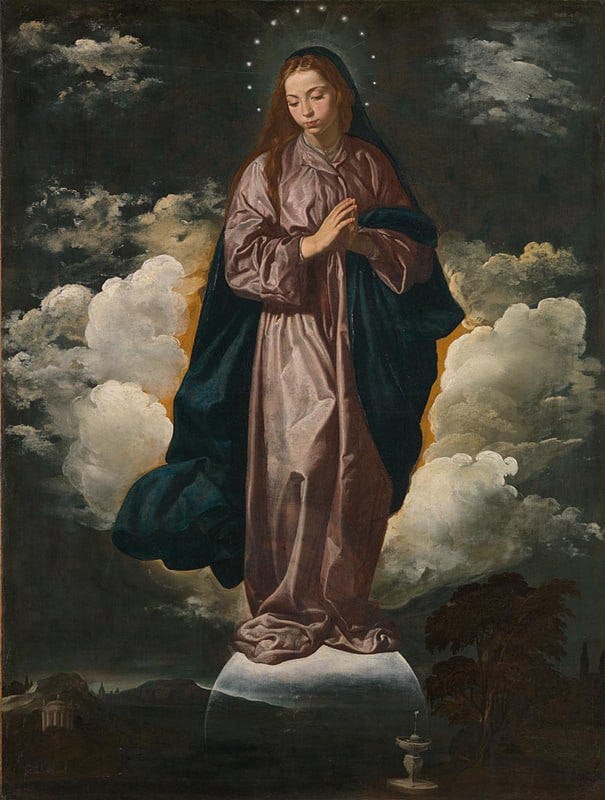
As a result of more sustained inquiries into the Eternal Feminine (das Ewig-Weibliche), I undertook a rereading of Goethe’s Faust. Having recently published an introductory study on the symbolism of the Mater Dolorosa, this return to the tragedy unfolded under a more refined perceptual lens—shaped primarily by Margarete, and only secondarily by Helen. The experience proved unexpectedly consuming, depriving me of several nights of sleep in a kind of febrile state.
What both fascinated and unsettled me were the final verses of the second part of the tragedy, sung by the Mystic Chorus:
Alles Vergängliche
Ist nur ein Gleichnis
Das Unzulängliche,
Hier wird’s Ereignis;
Das Unbeschreibliche,
Hier ist’s getan;
Das Ewigweibliche
Zieht uns hinan.
As one would expect, there is no adequate translation. Das Ewig-Weibliche is conventionally rendered as the Eternal Feminine, that which elevates what is insufficient toward what is real.
The metaphysical sources of this vision are well known. They include Jacob Böhme, Swedenborg, and the broader Gnostic tradition, condensed paradigmatically in the Pistis Sophia. Yet the mere study of sources did not strike me as the most appropriate method for grasping how this principle operates within Faust itself, particularly as it appears through Margarete. Nor was it my intention to conduct a retrospective inquisition of Faust as a character. In any case, such an approach fails to illuminate an even more elusive mystery—the figure of Helen, Margarete’s mirror, whose spectral apparition is not unique to Goethe but already haunts Christopher Marlowe’s Faust, in the famous line:
“Was this the face that launch’d a thousand ships, and burnt the topless towers of Ilium?”
I have long been aware that Mephistopheles—this figure who is at once buffoon and accuser—functions as a bridge between the medieval Satan and the modern devil, and that Faust’s fall is one whose language could only be modern. All of this is true. Yet, unlike the medieval Faust legends, in which salvation or damnation arrives depending on explicit Marian intercession, Goethe refuses to grant his character the despair of eternal damnation. Suspended between revolt and grace, he is compelled to construct a redemptive arc internal to the tragedy itself.
This leads the reader into a series of mirrored parallels between what we might call the traditional feminine and the way it reappears in a new age. That reappearance takes form in Margarete’s lament, sung in the “narrow space between the city walls and the houses,” a supplication addressed to the Mater Dolorosa, echoing the medieval hymn Stabat Mater:
Ach neige,
Du Schmerzensreiche,
Dein Antlitz gnädig meiner Not!
There emerges, then, another bridge — this time between medieval devotion and modern tragedy — one that allows Faust to be read, without exaggeration, as a magnum opus of the feminine, articulated through the Eternal Feminine itself.
The Eternal Feminine
We must start by recognizing that Goethe’s tragedy ultimately requires a shift in register. Margarete can function as a redemptive figure while remaining oriented toward Marian intercession precisely because her role does not arise from moral exemplarity, psychological symbolism, or sentimental conceptions of femininity. What grants her redemptive significance is her participation in a structure of indirect mediation: the Eternal Feminine.
Goethe may have been responsible for naming it as such, but the Eternal Feminine is a universal metaphysical principle. It expresses the idea that the “ladder” linking matter to the transcendent plane is constituted by a “Feminine Principle” that calls upward, toward ascent. Dante had already described this as a sacred, luminous force capable of dispelling darkness; in certain Eastern traditions, it is also conceived as a form of dormant energy, hidden or latent, awaiting its summons to restore cosmic equilibrium.1
In this way, the Eternal Feminine bears a universal “mediating” task, ordering the manifestation of Being and guiding the creature back toward its point of origin. In the symbolic tradition, this function is recurrently expressed through “liminal” images—those that signify passage, connection, and return. Jacob’s Ladder unites matter to the transcendent plane; the “mirror” reflects light without producing it; the threshold both separates and connects two worlds. All these myths and symbols remind us that ultimate reality—the sacred, the divine—remains bound to the material plane not through substantial identity but through mediating relation. More than this, such reality can be reached through an elevation that leads creation back to its origin, articulating life and death within a regenerative cycle. There is no fusion, no dissolution; only crossing, only return.
Consider the figure of Beatrice in Dante’s work, both in Vita Nuova and in the Divine Comedy. She appears as a celestial presence, an angel and queen, before whom evil recedes. Standing at the threshold of Paradise, she becomes for Dante both “guide” and ladder, the mediating figure through whom ascent is made possible. It is through her gaze that heaven discloses itself to him, reflected in her eyes as in a living mirror.2
Countless myths and rites recount divine or semi-divine women responsible for conducting men from one plane of existence to another. Among these narratives, the motif of flying women proves particularly eloquent, for such figures possess the power of transformation and enable the transcendence of death — either by leading men to rebirth or by granting them some form of immortality. In their most ancient expressions, these stories concern immortal beings capable of bestowing prosperity, offspring, elevation, and even the overcoming of mortality itself.3
These feminine figures personify the Eternal Feminine not because women are this principle, but because woman serves as an adequate symbol for that which transits between worlds. The feminine figure stands at the threshold, with one foot in the world and another oriented toward the celestial and infernal domains—those regions associated with birth, death, and regeneration.
An example that illuminates this structure with particular clarity is found in an ancient Chinese myth. According to narratives situated in illo tempore, Ehuang and Nüying were daughters of Emperor Yao, a primordial figure of Chinese mythology. They were given in marriage to Shun, Yao’s chosen successor, as part of a trial meant to test his virtue and capacity for rule. During their life alongside him, the two sisters repeatedly protected Shun from conspiracies and attempts on his life. When danger arose, they assumed winged mythic forms—dragon and phoenix—and instructed him in the art of flight, enabling his escape.
Traditional accounts describe episodes in which Shun was deliberately placed in mortal danger: ordered to repair a granary meant to be set ablaze, or sent to dig a well that was then sealed to entomb him. In each case, it was through the counsel of the two women that he survived, escaping by assuming the forms they revealed to him.
After Shun’s death, the sisters’ lamentations were said to resound along the banks of the Xiang River, where they were transformed into river deities and thereafter venerated as the Goddesses of the Xiang. In this final metamorphosis, their mediating role is definitively sealed as guardians of passage, protectors in moments of peril.
All these myths and legends would merit far more extensive analysis than can be undertaken here. For our present purposes, it suffices to observe that beyond the already noted characteristics of sacredness, mediation, guidance, ascent, and transition, these narratives also reveal something of utmost importance: they testify to an active feminine power through which the destruction of evil becomes possible. Active destruction, not passive.
As an active but still indirect force, across many traditional currents, the Eternal Feminine is consistently associated with lunar imagery.4 The Moon, Selene, becomes the celestial star that serves as an intermediary between the sublime light of the Sun and the dark earth—the great mediator between the world of pure spirit, symbolized by the fixed stars, and the shadowed sensuality of the earthly elements. It is also the Moon that marks time and governs the cycles, so that the creation and re-creation of the world become associated with the weaving of Time and Destiny, a task that is nocturnal and feminine.5
The Eternal Feminine designates, therefore, the very structure of cosmic mediation: the point where the transcendent inclines toward creation and where creation finds its path of return upward. As long as this principle remains intact, the symbolic order retains its coherence, vital continuity sustains itself, and suffering finds redemptive inscription within an intelligible totality. Break the principle, and the link between worlds ruptures; lose the mediation, and the way back is lost.
The Flower’s Fall
It is within this horizon of ruptured mediation that Margarete must be understood. Within her are gathered, with unbearable density, experiences that, within an intact symbolic order, would have been distributed and collectively borne. Clearly, she is not merely one tragic character among others; she is, rather, the historical condensation of a sacred order’s fall.
We must remember that Modernity is defined, above all, by the progressive rupture of all forms of mediation. What was once sustained by symbolic culture—liturgy, art, rite, devotion, hierarchy—is gradually displaced into the interior of the subject. This displacement brings about a decisive transformation in how suffering, guilt, and fallenness are experienced. Within the traditional order, suffering found inscription in ritual; guilt, in penance; death, in the promise of resurrection. Culture functioned as an extension of metaphysical mediation, preventing pain from concentrating entirely upon the individual. But once this structure collapses, suffering ceases to be mediated and comes to be lived in an immediate and totalizing manner.
In this sense, if Faust represents logos corrupted by hubris, Margarete condenses within herself multiple degraded manifestations of the feminine and, for this reason, bears every form of suffering. She is the violated maiden (korē) who, later corrupted, becomes a prostitute. She is also the mother who loses her child (mater dolorosa), and the mother who kills her own child (uroboros), when the promise of continuity is transmuted into death. After the profanation of purity, the wounding of maternity, the instrumentalization of fecundity, and the destructive inversion of life, only the collapse of mediation within her remains. It is at this point that hysteria (hystericus) finally reveals itself.
This concentration bears a distinctly modern character. It involves not merely an excess of suffering, but an excess of meaning imposed upon the individual. Margarete is compelled to answer for what exceeds her. She is, in every concrete sense, still a girl, scarcely more than a child; yet, caught within a demonic plot, she is driven to acknowledge guilt even when the causal chain of catastrophe cannot be fully attributed to her actions. External judgment becomes almost incidental here. What truly matters is that judgment migrates inward, taking residence within consciousness itself.
Something that Goethe makes explicit in the Cathedral scene, in which Margarete is tormented by an “evil spirit” that does not appear to be conjured by Mephistopheles, but rather summoned by her own mind. In this scene, the Chorus sings “Dies irae, dies illa”, the opening line of the famous thirteenth-century Latin hymn traditionally attributed to Thomas of Celano, which evokes the Last Judgment with intense fear and reverence. The verse belongs to the sequence of the Catholic Requiem Mass, and it centers on the destruction of the world and the rendering of accounts before God.
For this reason, Margarete’s descent into hysteria makes Walpurgisnacht seem like a walk in the park. Her suffering does not purify in the classical sense, resists self-redemption. In reality, it exhausts and unravels her. That is why she collapses into madness, revealing the absolute limit of the modern attempt to make individual experience the final locus of salvation.
Stabat Mater Dolorosa
It is only at this point — when modern tragedy reaches its limit and self-redemption is exposed as impossible — that the figure of the Virgin Mary, and medieval devotion, can be grasped in the full measure of their necessity. She offers an ontological and eschatological criterion, one that interrupts the tragic cycle and restores the mediation that had been lost, Civitas lunae.6 It is also at this point that the distinction between the Virgin Mary and the Eternal Feminine proves to be radical, though between the two there exists a legitimate symbolic relation.
The Eternal Feminine is an impersonal principle, supraindividual, which structures the order of the created world insofar as it constitutes the possibility of receiving form. In this sense, it is cosmological and ontological, not historical, not salvific, and not redemptive. It operates within the interior of manifestation, regulating the relation between form and matter, essence and substance, without ever surpassing this horizon.
The Mother of God (Theotokos), Blessed Virgin Mary, Queen of Heaven and Immaculate Conception, on the contrary, is not a cosmic principle, nor a symbolic hypostasis of the universal feminine (and she represents no archetype). She is a singular historical person, situated on the plane of revelation and of the economy of salvation. Her mediation is salvific because she participates in an event unique and unrepeatable. She belongs to the metaphysical-supra-cosmic domain because her function is directly bound to the incarnation of the Logos in the world.
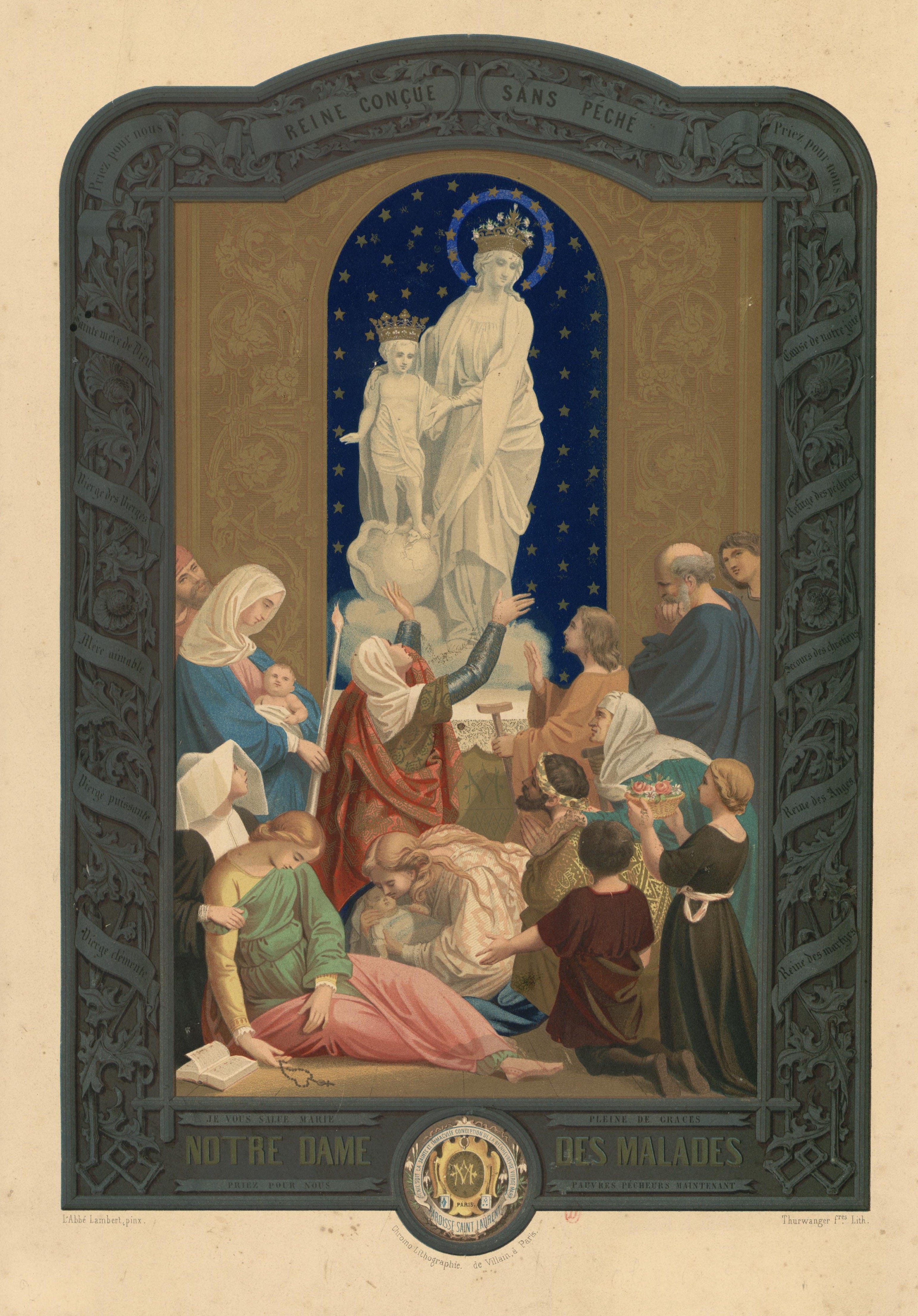
The Virgin Mary is that through which the order of manifestation is traversed by something which exceeds it. Therefore, the Eternal Feminine and its flying women may account for the possibility of mediation, while she gives that possibility its concrete and historical realization, unfolding from the very moment of the Fall, passing through the Incarnation, and reaching its fulfillment in the promise of the Apocalypse.
When Margarete, completely lost, inhabiting that liminal space—Goethe places her in the Zwinger, between the city walls and the houses, neither wholly without nor wholly within—prays her litany to the Mater Dolorosa, echoing the hymn Stabat Mater, she surrenders her destiny to something which exceeds her and traverses her. She requires merciful justice and discovers, therefore, the only means for her salvation.
Wer fühlet,
wie wühlet
der Schmerz mir im Gebein?
Was mein armes Herz hier banget,
was es zittert, was verlangt,
weiß nur du, nur du allein!
“Who can feel how pain burrows through my very bones?” she sings, “only you know, only you alone.” She attains the ladder, not any one, but Jacob’s Ladder, and even after being completely destroyed, she is still saved.
Saved even after having been publicly branded a prostitute by her own brother. Even after acknowledging her guilt in the calamity that befell her family. And even after killing her own child. Yes, she is condemned by the law of men (as she must be!), but that is not the law we are speaking of.
Margarete is saved by the merciful intercession of the Mater Dolorosa. She is saved, ultimately, because within her there subsists an invincible innocence. Her destiny was dragged along by forces that transcend her, ensnared in a satanic game of marked cards, subjected to a curse from which there was no escape.
And is not our own historical dissolution, in the end, a demonic plot? This fragmented persistence may also help explain why Modernity, having proclaimed the death of woman in every symbolic sense, did not witness the end of the feminine. Instead, it witnessed its proliferation into suffering, contradiction, and fragmentation.
It lies beyond the scope of these brief pages to examine how the Eternal Feminine was corrupted by revolutionary movements such as feminism, a task already undertaken in Luciano D., Autópsia do Feminismo. Ed. Caravelas, 2025. See, in particular, the chapter “The Electric Element: Woman as the Hope of Progress.”
Jr. Franco, H. Serpente, Espelho de Eva, A: Ensaios de Mitologia Medieval. Edusp, 2025.
Young, S. Women Who Fly: Goddesses, Witches, Mystics, and Other Airborne Females. Oxford University Press, 2018.
Rahner, H. Greek Myths and Christian Mystery. Cluny Media, 2021.
Eliad, M. Myths, Dreams, and Mysteries. Harper, 1962.
Civitas Lunae designates an ontological–metapolitical register, rather than a historical city, an institutional regime, or a normative blueprint for social organization. The term emerges from Anna K. Winters’s critical dialogue with the “third city” articulated by John Milbank, positioned between the civitas Dei and the civitas terrena. Winters affirms the need for such an intermediate register while radically reconfiguring its status.